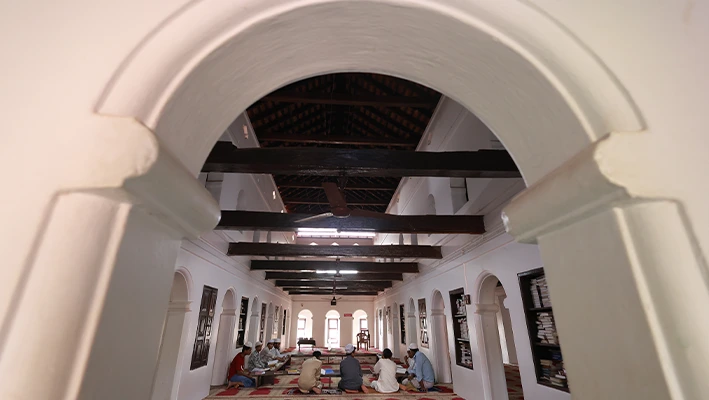
The Dars system, an early form of public education in Islamic religious studies, was introduced in Kerala through mosque-based learning.The term "Dars" refers to a lesson or course of study provided to students.This system was modeled after the Suffah School established by the Prophet Muhammad in Madinah.
In Malabar, the Dars system existed from the earliest times, with every grand mosque hosting a Dars within its premises.In the fifteenth century, Shaikh Zainuddin Makhdum, the senior, reformed the Dars based on the model of Kayalpatanam in the eastern region of Tamil Nadu, from where the Makhdums had settled in Malabar.
Shaikh Ahmad Zainuddin, known as the second Makhdum, was closely associated with the Ponnani Dars.He authored Fat’h al-Mu‘īn, a seminal work on Islamic jurisprudence, which later became the chief textbook of the Dars.The system thrived as a key educational institution for centuries, with prominent centers in Kodungallur, Quilon, Calicut, Ponnani, Chaliyam, and Tanur.It emphasized a holistic approach to Islamic education, encompassing all branches of knowledge relevant to human life.
However, by the early 20th century, the Dars system began to lose its prominence due to stagnation within the Mappila Muslim community.The reformer Makthi Thangal (d.1912) criticized the system, arguing that it no longer served the community effectively, and advocated for adopting modern methodologies in teaching and learning.