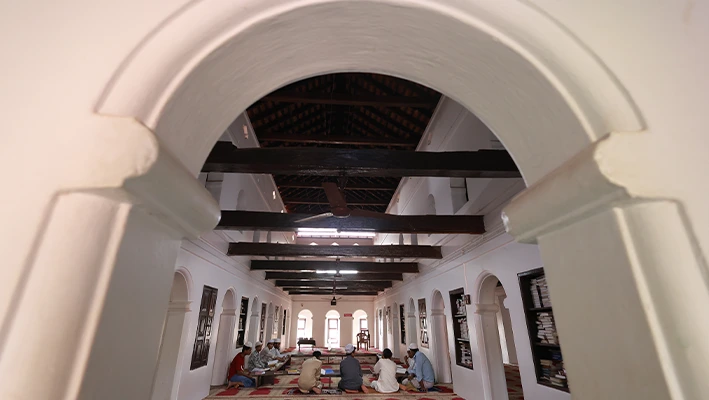
Chalilakath Kunhi Muhammad Haji, Sanaullah Makthi Thangal, and Vakkom Moulavi were pioneers of modern education among the Mappila Muslims. The Darul Uloom, established by Chalilakath, inspired the community to reform the traditional Dars system along modern lines. Further impetus came from the British, who introduced vernacular languages in Othupallis in 1904. Meanwhile, the creation of the Aikya Sangam, with its objective of reform, encouraged the community to establish schools for secular education. This effort was supported by the Maharajas of Travancore and the government, which appointed a committee and provided special concessions for Muslim students.
Muhammadan schools were established by the Travancore state as demanded by Vakkom Abdul Qadir Moulavi, who himself became the first inspector of these schools. A special board was created under his leadership to oversee their functioning. Lajnathul Muhammadiya in Alappuzha took the lead in spreading modern education in central Kerala. The Ma’danul Uloom, founded by M.M. Koyakunji in 1911, played a pivotal role in disseminating modern education in the Kannur region.
In 1925, with the establishment of the Malabar District Educational Board, new schools were opened, including special schools for girls. Mappila schools were also set up exclusively to cater to the educational needs of the Mappila community.
Following the Malabar Rebellion of 1921, the region experienced acute poverty and a rise in the number of orphans. Philanthropists stepped in to provide support, and Maulana Qusuri of Punjab founded JDT Islam in Calicut in 1922. In 1943, an orphanage was established at Tirurangadi by M.K. Haji, offering asylum to victims of cholera in the region. The government also encouraged Muslim managements to start oriental schools in places like Tirurangadi and Edavanna.
A significant leap in modern education came in 1948 with the establishment of Farook College at Feroke, Calicut, inspired by Abussabah Ahmad Ali Moulavi. The college became a miniature version of Aligarh Muslim University in Malabar, attracting students to pursue higher studies at Aligarh. Over time, more colleges for higher education were established across the region. This progress was further accelerated with the foundation of the Muslim Educational Society (MES) in 1964 under the leadership of P.K. Abdul Gafur. MES played a crucial role in establishing aided colleges at Mannarkkad, Mampad, Kodungallur, Ponnani, Marampalli, Nedumkandam, and Valanchery, along with higher secondary schools.
Later, the government encouraged private investment in education. Students who previously relied on other states for higher education, particularly in engineering and medicine, began joining private medical and engineering colleges within Kerala. MES took the lead by establishing an engineering college at Kuttippuram and a medical college at Perinthalmanna. Muslim managements started medical and engineering colleges across Kerala, surpassing other communities in this field.