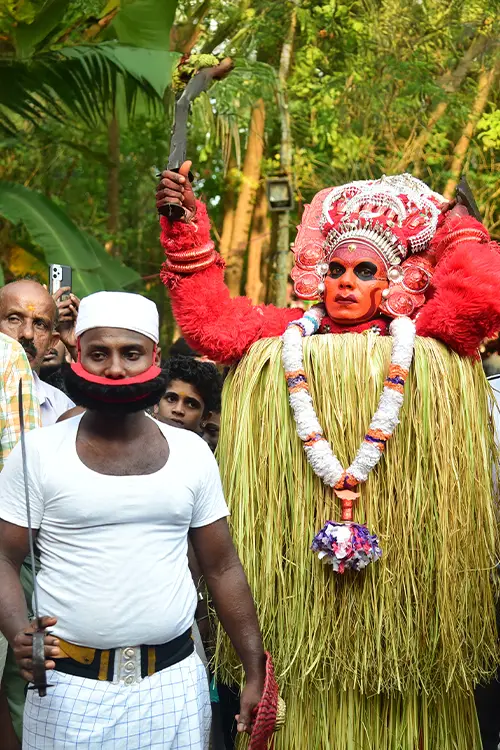
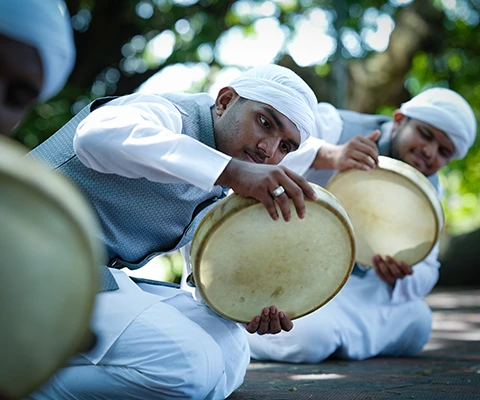
One of the adaptations of kalaripayattu among the Mappilas is paricha kali, which evolved into a unique Mappila martial tradition known as parichamuttu.In this art form, participants wear white shirts and green caps, and before performing, sing Mappila songs and offer prayers to Allah, the Prophet Muhammad, and Sufi saints.
The oppana dance of Mappilas closely resembles kaikottikkali and vattappattu, which are practiced by Hindu women.Historical records suggest that the word oppana existed in Malabar from ancient times, and certain temple processions were known as oppana vekkal. Today, oppana has developed into a nationally recognized art form and is performed at various national festivals.
We have an abundant collection of Mappila folk songs called Mappilappattu, whose origins are deeply rooted in indigenous culture, with modes or ishals derived from old Dravidian styles.For example, the mode tongal resembles the style of ‘Maveli Naduvanidum Kalam’, adi antham is similar to ‘Omanakkuttan Govindan’, and pukainar is the Mappila version of the Hindu vanchipattu (boat song).Indian languages such as Sanskrit, Hindustani, Kannada, and Tamil have significantly contributed to the evolution of Mappila folk songs.
The influence of Malayalam poets like Cherusseri, Ezhuttachan, and Kunchan Nambiar is evident in the Mappila songs written by Moyin Kutty Vaidyar.Suranat Kunchan Pillai compares the blending of different languages in Mappila songs to the works of Unnayi Varier.The folk song malapattu is the Mappila version of Hindu kirtans, while pakshippattu has a Keralite counterpart called kilippattu in Malayalam.Other Mappila folk songs, such as kuppipattu and kurathippattu, reflect traditions deeply connected to local culture.
Mappila folk tales also highlight communal harmony.The stories of Kunhayan Musliyar and Mangattachan, as mentioned above, vividly illustrate the coexistence of different communities in the Zamorin’s kingdom.Kunhayan Musliyar, a Muslim scholar of the eighteenth century, is known for his wit and humor in Mappila circles.Mangattachan, the chieftain of the Zamorin, was his close friend.There are various stories highlighting the deep friendship between Kunhayan Musliyar and Mangattachan.Their relationship was marked by mutual respect, humor, and camaraderie, reflecting the communal harmony that existed in the Zamorin’s kingdom.Their friendship became legendary, symbolizing the spirit of coexistence between communities in Malabar.Even today, tales of Kunhayan Musliyar and Mangattachan are fondly remembered as examples of interfaith unity and mutual respect.