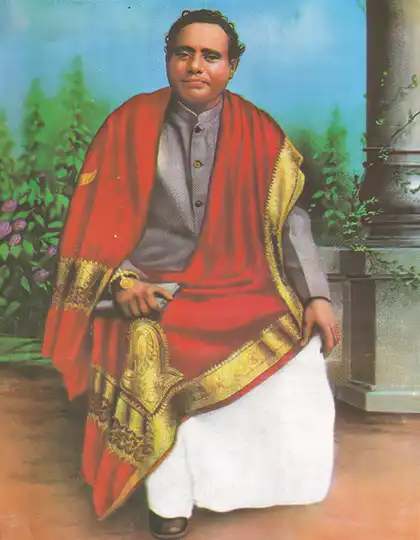
Kumaran Asan, also known as ‘Chinnaswami’, was one of Narayana Guru's most prominent disciples, dedicating his poems, articles, and speeches to disseminate Guru's philosophy globally. A remarkably gifted poet, he holds an unparalleled position in Malayalam literature.
From a young age, Kumaran's exceptional intelligence was recognized by Guru during a visit to the family home. With the family's consent, Guru took Kumaran under his wing for three years in Aruvippuram, where the young boy delved into profound Vedanta texts and practiced yoga. Guru personally fostered Kumaran’s innate talents, arranging for him to live and study with Dr. Palpu, then a high-ranking officer in Mysore. Dr. Palpu’s guidance, alongside Guru’s, was pivotal in shaping his personality.
Kumaran furthered his education at the Sanskrit College in Bangalore, studying logic and grammar, before continuing his studies in Calcutta. His time in Calcutta was instrumental in laying the foundation for his English studies, and he returned a transformed man, imbued with progressive thoughts and deeply assimilated into Bengal’s cultural renaissance movement.
In 1903, upon the registration of the S.N.D.P. Yogam, Kumaran Asan assumed the role of secretary at Guru’s instruction. Through his poignant poetry, Asan exposed the inherent meaninglessness and destructive power of caste. He also took on the responsibility of editing ‘Vivekodayam’ (Dawn of Wisdom), the official newspaper of the S.N.D.P. Yogam. Asan was profoundly influenced by Buddha, who prioritized the liberation of others, and by Narayana Guru’s ascetic life, driven by a desire for service. Kumaran Asan’s material and spiritual upliftment stemmed directly from this profound influence, fostering a deep, soulful bond with Guru. Their shared interest in the Shaiva tradition of Hinduism is evident in their devotional works.
Following the Aruvippuram consecration, Guru sought to channel the community’s awakening into modernizing energy, with Asan serving as his indispensable right hand. Asan’s Malayalam translation of Vivekananda’s ‘Raja Yoga’ was dedicated to Guru, underscoring this bond. His services as a member of the Praja Sabha were invaluable to the community's progress. In many of his poems, composed for societal cultural awakening, the spiritual light of Gurudeva's principles shines through, as he masterfully used poetry to reinforce Guru's messages. Works like ‘Veenapoovu’, ‘Nalini’, and ‘Chinthavishtayaya Seetha’, ushered in a new poetic culture, while ‘Duravastha’ and ‘Chandalabhikshuki’ reflected Guru’s philosophical vision. In his hymn ‘Guru’, Asan reverently praises Guru as a living deity, leaving no doubt that the profound spiritual background and wisdom in Asan’s poetry are deeply influenced by Sree Narayana Guru.


