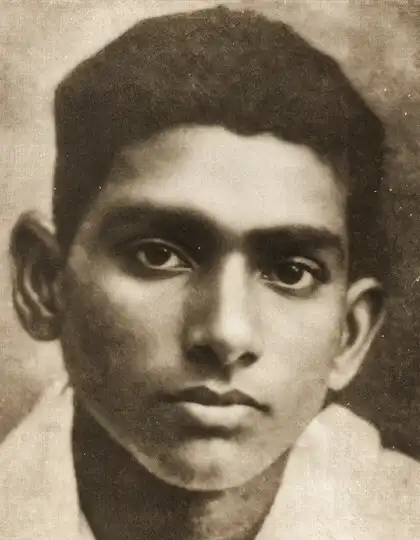
T.K. Madhavan was a disciple of Guru who stood at the forefront to implement Guru's message of "Be strong with organization." He actively participated in Guru's activities to start a Sanskrit school in Aluva. The experience gained through these activities led him to the formation of the newspaper ‘Deshabhimani’. Through ‘Deshabhimani’, he propagated his ideas for social reform and worked tirelessly for social justice.
Civic equality was one of the main ideas T.K. Madhavan proposed in the social sphere. It was his way of countering the denial of rights in schools, public roads, and public institutions. T.K. Madhavan took up Guru's work of eradicating untouchability. He pushed for the inclusion of the eradication of untouchability as the first item on the Congress party’s agenda. He was also the chief architect of the Vaikom Satyagraha. It was a significant act of resistance in Kerala’s social history.
The Guruvayoor Satyagraha in 1931 and the Travancore Temple Entry Proclamation in 1936 were also inspired by T.K. Madhavan's ideas of resistance. As the secretary of the S.N.D.P., he constantly reminded the Ezhava community that Guru's messages were meant to be put into practice. He had an extraordinary ability to charm any audience with his eloquence. As a member of the Sree Moolam Praja Sabha, he dared to argue that untouchability should be abolished by a public proclamation issued by the Maharaja. He realized that the initial step towards securing the rights of the oppressed involved gaining access to temples and boycotting untouchability.
T.K. Madhavan was a nationalist leader rather than a communalist. His efforts helped to bring the Ezhava community into the national mainstream. His influence was pivotal in getting the Indian National Congress and the national leaders, including Mahatma Gandhi, to support the freedom struggle of the oppressed in Kerala. Moreover, Narayana Guru's message of abstinence from alcohol garnered attention on the national level owing to his efforts.


