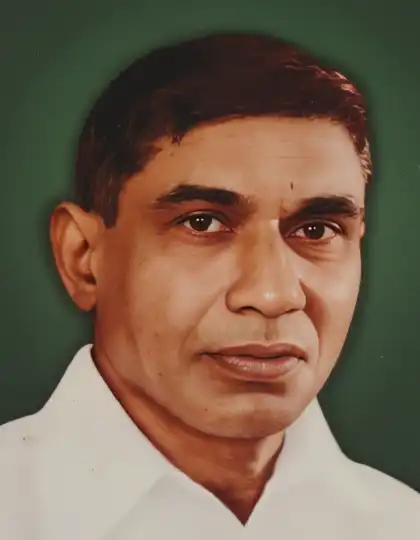
Sahodaran Ayyappan, an unyielding social reformer, dedicated his life to combating caste discrimination after encountering Narayana Guru at the Cherai Gowreeswara Temple consecration. His subsequent endeavours largely focused on amplifying Guru's ideals.
Ayyappan served four years as President of the S.N.D.P. Yogam and as a legislative assembly member in both Kochi and Travancore-Cochin. He believed that upholding righteousness was humanity's highest calling and was a powerful orator whose speeches urged disadvantaged communities to reject social evils and irrational beliefs. Recognizing caste discrimination as unscientific, harmful, and unnecessary, he challenged superstitions and customs with scientific logic. He understood that true equality for Ezhavas lay in assimilating with those deemed lower than them, initiating 'Mishrabhojanam' (inter-dining) with lower-caste individuals to achieve this. This act led conservative Ezhavas to derisively nickname him 'Pulayan Ayyappan,' and it was from this movement that the 'Sahodara Sangham' (Brotherhood Organization) emerged.
Despite facing considerable opposition to ‘Mishrabhojanam’, Ayyappan found support in Guru, who sent a message to the Sahodara Sangham affirming that inter-marriage and inter-dining were acceptable since all humans belong to one caste. These profound words became a powerful proclamation against caste discrimination, and Sahodaran Ayyappan widely distributed printed copies. He later founded the newspaper 'Sahodaran' to further disseminate his ideas, which earned him the moniker 'Sahodaran Ayyappan’.
While Guru viewed the temple as a vehicle for social transformation, Sahodaran perceived it as an institution that exploited dharma for commercial gain. Guru envisioned human unity through the essence of religion, whereas Ayyappan famously declared that a religion dividing humanity was unnecessary. Despite their differing approaches, their core ideological vision remained unified. Ayyappan’s vehement opposition to the absurdities and superstitions within Hinduism infused his poems with strength. He composed many popular and inspirational poems, even predating the Progressive Literary Movement, prioritizing ideological propagation over purely literary aims. Both Guru and disciple addressed the social problem of inter-religious conflict. Guru sought reconciliation, while Ayyappan believed that a permanent solution lay in the complete rejection of religions.


