It is a traditional martial art form that originated in the Malabar region of Kerala. The term ‘Kalari’ refers to a gymnasium where rigorous training is provided to discipline both the mind and body. ‘Payattu’ means training or exercise, specifically in martial arts. Variations of this practice are found in Sri Lanka and other parts of the world.
Historically, Kalarippayattu was an essential part of military training, particularly among the Nairs, Ezhavas and later among the Koyas and Kunhalis. Students are typically initiated into Kalari training from the age of seven. Under the guidance of the Gurukkal (master), the training begins with the chanting of litanies, followed by an oil massage to prepare the body.
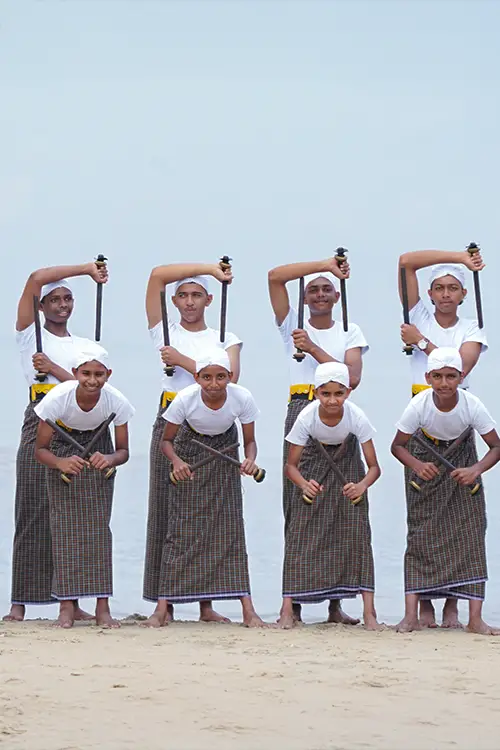
Students train on an empty stomach and arrive at the Kalari at dawn. They wear a tightly wrapped cotton cloth (kacha), which is six feet long and one foot wide. The training is preceded by the vaythari, or verbal commands of the Gurukkal. Each combination of gestures and steps is known as an adavu, which is repeated until the student masters it.
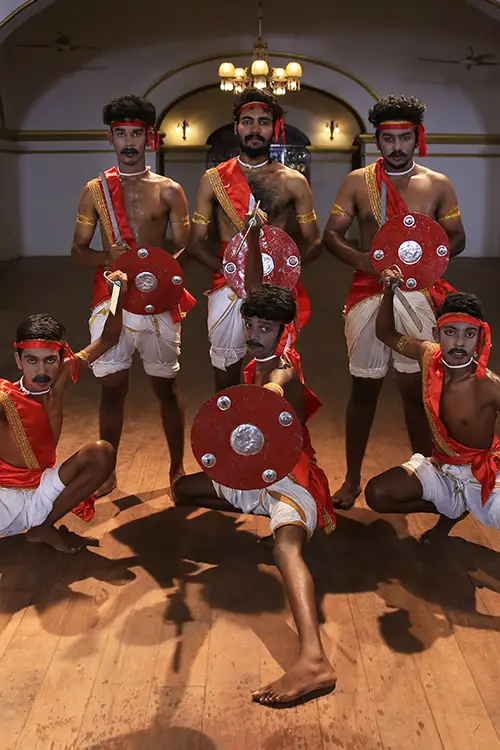
Once the body is trained, students are introduced to weaponry. The muchan or cheruvadi, a wooden stick, is the first weapon used to strike enemies and defend against attacks. Advanced training includes weapons such as the dagger (kathi), sword (vaal), spear (kuntham), and the flexible sword (urumi).
Each Kalari is led by a skilled Gurukkal, who commands great respect from the trainees. Historically, trained warriors were recruited by local chieftains and kings as soldiers. The Mappilas, who served in the armies of local rulers, were also trained in Kalarippayattu.
Kalarippayattu encompasses a wide range of techniques, including strikes, kicks, grappling, preset forms, weapon combat, and even healing methods. Different regions developed their own variations, leading to three distinct styles: northern Kerala style, central Kerala style, and southern Kerala style.