Enchanting Kerala
October in Kerala
When the Gods Travel, Learning Begins and Theyyam Awakens
October arrives in Kerala without quite announcing itself.
The rain is still around. The forests are full. The rivers have not forgotten the monsoon. In Thiruvananthapuram, though, October begins with the stage lights coming on.
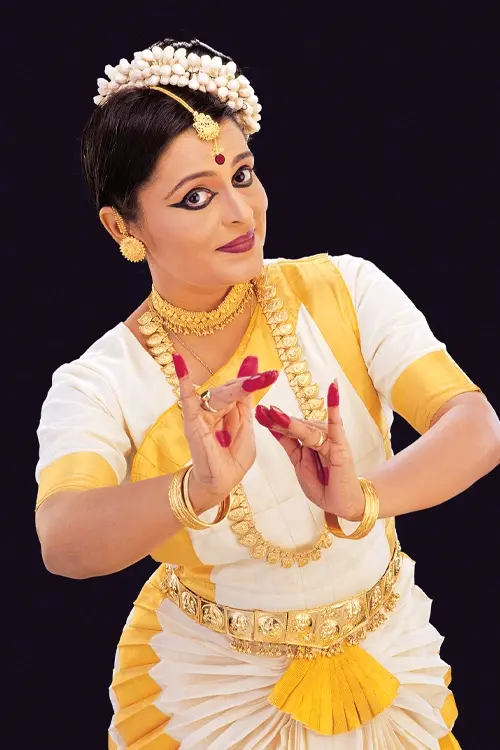
The Soorya Festival, now in its 49th edition, opens on October 1 and runs for 111 days, filling the city with music, dance, theatre, cinema, painting, poetry and more. More than 2,000 artists are expected to take part. It is the first edition since the death of its founder, Soorya Krishnamurthy, who began the festival in 1977.
For almost half a century, Soorya has been part of the city's rhythm. It returns each year, carrying something of the past with it and making room for whatever comes next.
Then October begins to scatter.
In the temples, books disappear beneath flowers. Instruments and tools are put away. In Koratty, church bells call people towards Muthy. On the water, long boats gather speed. In the north, somewhere behind a curtain of preparation, a face is painted and a towering headgear waits to be worn.
October moves between worlds.
There are forests and serpent groves, three deities crossing an old border, a child's first letter, a hill climbed in search of a goddess, scholars arguing beneath the shadow of a temple, boats racing through backwaters and, finally, Theyyam returning with the coming of Thulam.
It is a month of movement. And also a pause.
When the Forests Take Their Turn
October 2-8 | Wildlife Week
The month turns towards the forest.
Wildlife Week, observed across India from October 2 to 8, brings attention to Kerala's forests and wildlife. The Kerala Forest Department's 2026 programme includes photography, poster design, travelogue, short-film and reel competitions among its activities.
There is something fitting about beginning here.
Before the temples, before the processions, there is the forest - older than the shrine, older than the road, holding water in its roots and shade beneath its canopy.
Kerala's forests are not merely green stretches on a map. They are habitat, watershed and memory. Some are also places where belief has allowed the natural world to remain largely untouched.
A forest is not scenery. It is inheritance.
Beneath the Serpent Grove
Vettikode | Alappuzha
At Vettikode, the old relationship between belief and landscape is still visible.
The Sree Nagaraja Swami Temple becomes the centre of Ayilyam Mahotsavam, dedicated to the serpent deities. Kerala Tourism lists the 2026 celebration on October 6, with the procession to Meppallil Illam and the Sarpabali - a sacred ritual invoking the serpent gods.
But the festival cannot really be separated from the sarpakavu or the shrines dedicated to the serpent gods. A serpent grove is land left to itself. Trees grow where they will. Creepers climb. Water gathers in the shade. There is no need to clear the wilderness to make a sacred place. The wilderness is a sacred place.
Perhaps that is why the old groves feel different. Their walls are trees. Their silence is part of the ritual. At Vettikode, the serpent is not an idea detached from the earth. The earth is part of the worship.
When the Gods Cross a Border
Thiruvananthapuram | Navaratri - a nine-night festival celebrating the goddess in her various forms
During Navaratri, three deities leave Tamil Nadu and begin a journey towards Thiruvananthapuram.
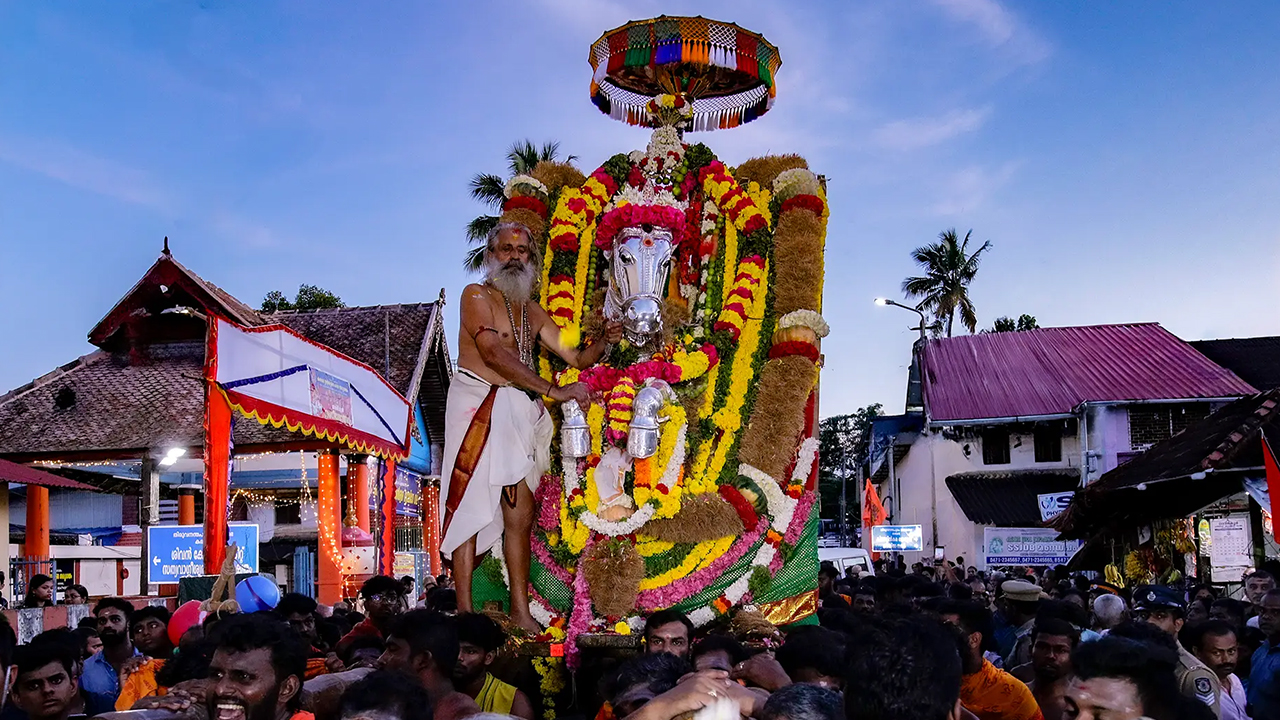
Goddess Saraswati, Velayudha Perumal and Munnuttinanka travel through Kaliakkavilai on the border between Tamil Nadu and Kerala and onwards to the capital, continuing a tradition that reaches back to the erstwhile Travancore period. Today, the journey crosses a state border. The tradition itself is older than that border.
In Thiruvananthapuram, the three deities take their places for the Navaratri observances - Saraswati at the Navaratri Mandapam, Velayudha Perumal at Aryasala and Munnuttinanka at Chenthitta.
There is something moving about a road remembered for so long that the journey itself becomes sacred.
The Days When Work Begins Worship
Puja Veyppu | Navaratri
Then comes the quiet part. Books are closed. Musical instruments are put away. Tools of work are placed before the goddess. For a few days, the things that usually occupy our hands are left alone. A book remains unopened. A violin gathers silence. The tools wait.
Perhaps this is what makes Puja Veyppu so beautiful. It does not ask us to do more. It asks us to stop. Knowledge, music and work are acknowledged precisely by putting them aside.
And then, on Vijayadashami, they return.
Music Under the Lamps
Thiruvananthapuram | October 11-21
Back in the capital, Navaratri settles into music. At the Navaratri Mandapam, the 2026 Navaratri Sangeetholsavam (Music Festival) is scheduled from October 11 to 21. The lamps are low. The space is intimate. The music belongs to the place as much as to the musician.
Nearby, the Alpashi Utsavam at Sree Padmanabhaswamy Temple is listed from October 11 to 20. For a few October evenings, Thiruvananthapuram seems to breathe to an older rhythm - music, lamps, temple bells, footsteps on stone.
A Child Writes Its First Letter
Vidyarambham, the initiation into learning | Vijayadashami
A child's finger is guided across a bed of rice. One letter appears. At Panachikkadu Saraswati Temple in Kottayam, as in homes and temples across Kerala, Vidyarambham marks the beginning of a child's learning.
The first mark is tiny. What lies behind it is not. There will be books and songs, numbers and stories, mistakes and discoveries. There will be teachers, questions and the slow business of finding one's way through the world.
Perhaps every beginning is like that. We make one small mark and call it a future.
Koratty Muthy and the Weight of Faith
Koratty | Thrissur
October's bells are not all temple bells.
At Koratty, the annual feast of Our Lady of Immaculate Conception brings devotees to the church of Koratty Muthy. In 2026, the main feast falls on October 11.
There are processions, prayers and offerings. Thulabharam is among the traditions associated with the feast, as is the offering of Poovankula, the plantain closely linked with Koratty Muthy.
But the deeper story is in the returning. People come because their parents came. Because a promise was made. Because the name belongs somewhere in the family story. Faith has its own geography. Sometimes it is a temple. Sometimes a church. Sometimes a hill, a grove or a road is taken by a procession year after year.
At Koratty, it has become part of the memory of a place.
Where 'Thulam' Begins on a Hill
Rayiranellur | Palakkad | Thulam 1
The Malayalam calendar has its own way of turning the year. Thulam, the seventh month, begins around the middle of October. At Rayiranellur, the first day of Thulam brings pilgrims to a hill near Pattambi. In 2026, the annual pilgrimage falls on October 18.
The hill is associated with Naranathu Bhranthan, the legendary figure who is said to have pushed a huge stone uphill only to watch it roll back down.
At the summit stands the shrine of Durga. There is something almost mischievous about the old story: all that effort, knowing the stone would come down anyway. And yet people keep climbing. Perhaps that is the point.
Not everything worth doing is done because it will remain done.
When the River Becomes a Racecourse
Champions Boat League | October
Then the river gets loud.
The chundan vallams return to the water.
The October 2026 Champions Boat League races happen at Kottappuram on October 4, Marine Drive in Kochi on October 10, Piravom on October 17, Thazhathangadi on October 24 and Pulinkunnu on October 31.
Long boats. Dozens of rowers. One rhythm. The first oar strikes the water. Then another. Then another. Soon the boat seems less like a collection of people than a single moving body.
Along the banks, the villages gather. The race lasts minutes. The sound stays.
Thulam Is the Month. Revathi Is the Star.
Revathi Pattathanam | Kozhikode
The Malayalam month of Thulam has another story to tell - this time in words.
At the Tali Mahadeva Temple in Kozhikode, Revathi Pattathanam is a seven-day gathering associated with scholarship, debate and learning. The name itself carries a clue: Thulam is the Malayalam month; Revathi is the asterism with which the traditional beginning of the assembly is associated.
The 2026 event is listed for October 25.
For centuries, the temple has been associated with this unusual celebration of the mind. Scholars gather. Arguments are made. Knowledge is not quietly possessed; it is brought into the open and tested.
There are stories surrounding the origins of the Pattathanam, including a traditional account linking its establishment to the Zamorin and an act of penance. Such accounts belong to the tradition surrounding the festival rather than settled history.
What matters now is what survives.
For seven days, a temple becomes a place where ideas are allowed to quarrel.
In a month that began with a child's first letter, Revathi Pattathanam brings learning much further down the road.
The first letter becomes an argument.
Thulam 10: When the North Begins to Change
Kannur and Kasaragod | Theyyam season
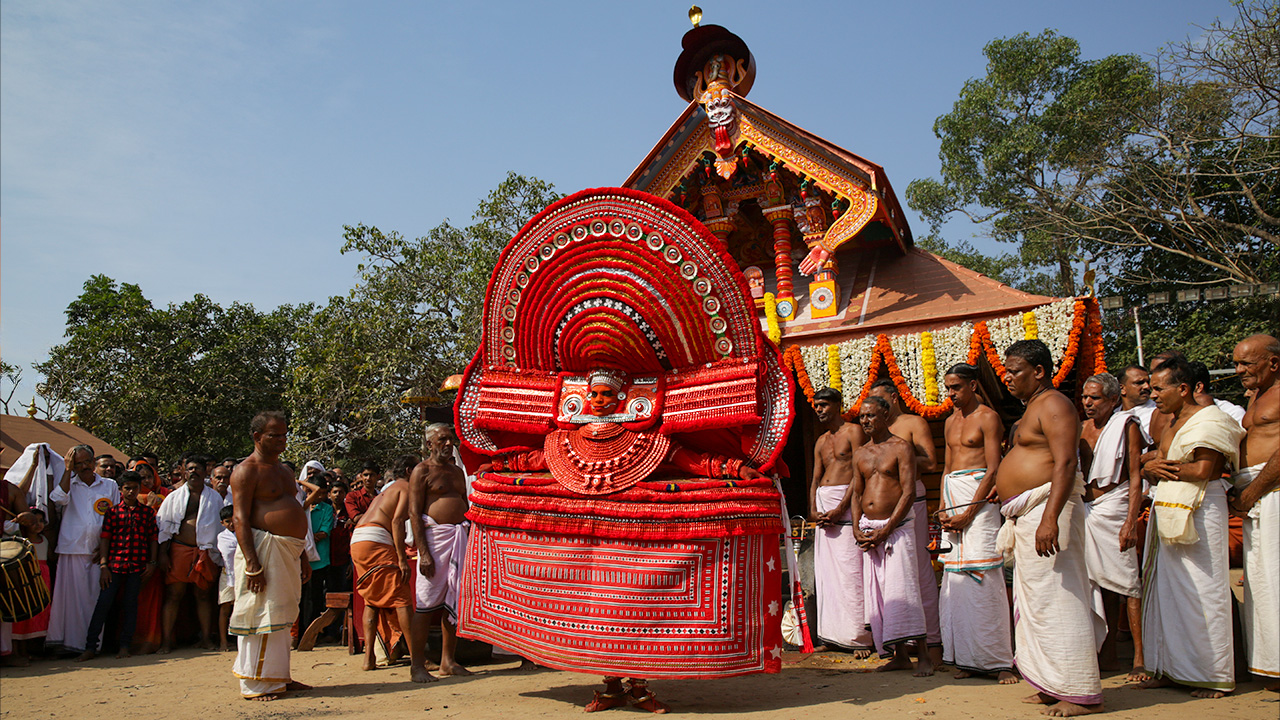
And then comes the tenth day of the Malayalam month of Thulam. This is when the Theyyam season traditionally begins in northern Kerala, stretching across the months that follow.
The change is almost theatrical, but Theyyam itself is not theatre. A face disappears beneath colour. A body disappears beneath the costume. A towering headgear changes the shape of a human being standing beneath it. The performer becomes the vessel through which a deity or ancestral presence enters the sacred space.
The photographs remember the colours. The community remembers the deity. The shrine. The family. The old stories. The obligations that return with every season.
Theyyam belongs to a particular kavu, a small place of worship, a particular village and the people whose memories live there. Take it away from that setting and much of what it means is lost.
The first performances therefore feel less like the opening of a show than the reopening of something very old. Visitors arrive as guests.
The sacred space has its own rules. Follow them. Ask before photographing. Watch before reaching for the camera. Some things are better understood by standing quietly at the edge.
When Thulam Brings the Rain
There is another calendar turning in October.
Around the middle of the month, the northeast monsoon arrives. In Kerala, the rains of Thulam are known as Thulavarsham. The word itself is simple: the rains of Thulam.
But you can feel the change. The clouds gather again. The earth darkens. The roads shine after rain. The calendar has turned. The rain has changed direction. And in the north, the gods have begun to dance.
A Month for Taking the Long Way
Perhaps that is why October never feels like simply another month in Kerala.
It is a threshold.
The forest turns green with rain. The serpent grove holds its silence. Three deities cross an old road from Tamil Nadu. Books are closed. A child writes its first letter. A hill fills with pilgrims. Scholars gather to argue. Boats cut through the backwaters.
Then Thulam arrives. And with it, the rains, the season of Theyyam and another way of counting time. So take the long way through October. Follow the road after the rain. Stay a little longer in the temple town. Listen to the bells. Watch the river. Climb the hill. Let the procession pass. There is no need to collect all of Kerala in a single journey.
Somewhere between the forest and the shrine, between a child's first letter and an old scholar's argument, between the rain and the painted face of Theyyam, the month begins to feel less like a calendar and more like a story.
October begins with art. Then the forest speaks. The gods travel. Knowledge pauses, then begins again. The river races. Thulam arrives with rain. And in the north, the drums begin. Kerala does not hurry through October. Neither should you.